A Survey of Activity Types on Platforms Like tk999
A betting platform is rarely a single product. It is better understood as a collection of different activity types gathered under one login, each with its own rhythm, its own interface, and its own set of user expectations. A visitor who signs in expecting one kind of experience often discovers several others sitting alongside it. This survey catalogues the main categories of activity that tend to appear on platforms like tk999, describing what each one involves rather than arguing for or against any of them. The goal is a plain inventory: what is there, how it is typically organised, and what a user encounters when moving between sections.
Account Access and the Single Login Structure
Before any activity begins, there is the account layer. On most modern platforms, this is a single registration that then unlocks every other section. The process is usually short: a phone number or email address, a password, sometimes a country selection, and a confirmation step. Because the audience is largely mobile, the flow is designed for a small screen, with large buttons and minimal typing.
The single login structure matters because it shapes how users behave. Instead of maintaining separate accounts for separate products, a person moves between sections with one identity. That means a balance, a transaction history, and a profile are shared across everything. For the platform, it means a unified view of activity. For the user, it means fewer passwords and less friction, but also less separation between one type of activity and another.
Account security sits underneath this layer. Two-factor options, device recognition, and withdrawal verification are common. These are not activities in themselves, but they determine how smoothly the rest of the catalogue can be used. A platform with a slow verification step can make even a well-designed game section feel cumbersome.
Sports Markets and Pre-Match Selections
The first broad category is sports. Football dominates in most South Asian markets, and a platform aimed at Bangladeshi users will typically lead with it. Cricket is the other major pillar, given its cultural weight in the region. Beyond those two, basketball, tennis, volleyball, and kabaddi often appear, along with motor racing and combat sports.
Pre-match markets are the classic form. A user browses upcoming fixtures, selects an outcome, and places a selection before the event begins. The variety comes from the market types rather than the sports themselves. A single football match might offer match winner, both teams to score, total goals, half-time result, correct score, and dozens of player-level propositions. Cricket adds top batsman, top bowler, total runs, and method-of-dismissal markets.
What a catalogue-style survey reveals is that the number of sports is usually smaller than the number of markets. Ten sports with deep market coverage produce far more options than thirty sports with only a winner market each. Users who enjoy analysis tend to gravitate toward the deeper markets, while casual visitors often stay with the simplest ones.
Live In-Play Betting and Real-Time Markets
In-play activity is a distinct category because the experience is fundamentally different from pre-match. The odds move continuously, markets open and close as events unfold, and decisions happen in seconds rather than hours. A live football match might see its match-winner odds shift after every goal, while total-goals markets adjust with the clock.
Live cricket is especially dynamic. Run rates, wickets, and required rates create a constantly changing set of propositions. Tennis offers game-by-game and point-by-point markets. Basketball moves quickly enough that a user can watch a quarter unfold while the numbers update in real time.
The interface for live betting is usually more compact than the pre-match view. Odds are displayed in tight grids, and the event feed is prioritised. Some platforms add a visual tracker or a simplified scoreboard. The catalogue entry here is not a separate product but a different mode of using the same sportsbook, and it tends to attract a different kind of user: one who prefers reaction over preparation.
Casino-Style Games and Table Formats
The second major pillar is casino-style gaming. This is where the range of activity types expands considerably, because the category covers everything from simple chance games to skill-influenced table formats. The common thread is that outcomes are generated by software rather than by a sporting event.
Slot-style games form the largest group. They vary by theme, reel layout, payline structure, and bonus mechanics. Some are simple three-reel formats; others use cascading symbols, expanding wilds, or free-spin rounds. The catalogue is often organised by provider, by popularity, or by volatility, which gives users a way to narrow a very large list.
Table games form a second group. These include roulette variants, blackjack, baccarat, and poker-style formats. Each has its own ruleset and its own pace. Roulette is fast and chance-driven; blackjack involves decisions that affect the outcome; baccarat is largely a matter of selecting a hand. For a survey, the important point is that these are distinct activities with distinct rhythms, even though they sit under one casino heading.
Some platforms also include instant-win games, scratch-card formats, and crash-style titles where a multiplier rises and the user decides when to stop. These sit between slots and table games in terms of complexity and tend to appeal to users who want short sessions.
Live Dealer Sections and Streamed Tables
Live dealer gaming is a separate category because it combines a streamed human element with digital betting. A real dealer runs a real table, and the user places bets through the interface while watching the action. The result is a hybrid: the social feel of a physical table with the convenience of a screen.
Common formats include live roulette, live blackjack, live baccarat, and various game-show-style titles that blend a wheel or card mechanic with a presenter. The pace is often slower than software-generated games because the dealer must physically complete each round. That slower rhythm is part of the appeal for some users and a drawback for others.
Streaming quality, table limits, and the number of simultaneous tables all shape the experience. A platform with many tables can offer a range of stakes, from low-limit casual tables to high-limit private ones. The catalogue entry here is defined less by game rules than by the presence of a live host and a real-time video feed.
Mobile App Access and On-the-Go Play
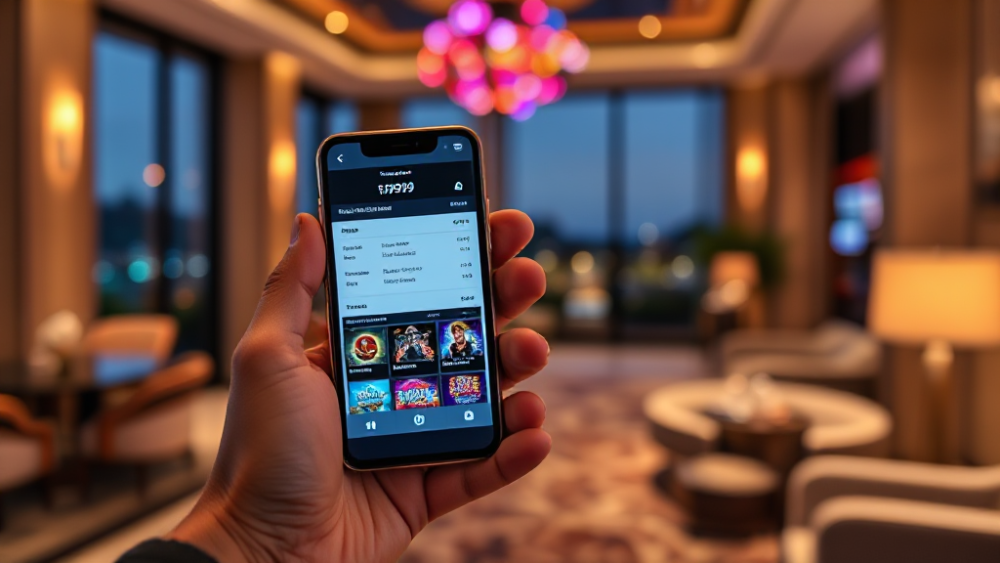
Because most users in this market are on phones, the mobile app is effectively its own activity category. It changes how the other categories are used. A downloadable app typically offers faster loading, push notifications for events or promotions, and a layout optimised for touch rather than for a mouse.
The app usually mirrors the browser version but with adjustments. Sports markets may be grouped differently, live sections may be prioritised, and the cashier may be simplified. Some platforms offer a lighter web app for users who do not want to install anything, while others push the native download for the best experience.
From a catalogue perspective, the app is not a separate product but a different access route to the same set of activities. It matters because it determines when and where those activities happen. A user with an app can place a live selection during a commute; a browser-only user is more likely to plan sessions at a desk. The distinction shapes usage patterns more than it shapes the games themselves.
Payments, Promotions, and Support Layers
Underneath every activity sits a payment and support layer. Deposits and withdrawals are the practical bridge between a user and any game or market. Common methods in this region include mobile financial services, bank transfers, and card options. Speed and reliability vary, and the cashier section is where users judge a platform most harshly.
Promotions form a second supporting layer. Welcome offers, reload bonuses, free spins, and odds boosts are typical. Each is usually tied to a specific activity type, which means the promotional calendar often mirrors the catalogue itself. A sports bonus applies to sports markets; a casino bonus applies to slots or table games; a live-casino offer applies to streamed tables.
Customer support is the third layer. Live chat, email, and sometimes phone support handle questions about verification, withdrawals, and account issues. A responsive support channel does not add a new activity, but it determines how comfortably the existing ones can be used. In a survey of this kind, it is worth noting that support and payments are the connective tissue that holds the rest together.
How the Categories Fit Together
Seen as a whole, a platform like tk999 is less a single destination than a set of adjacent rooms. Sports and live betting share an analytical mindset. Casino-style games and live dealer tables share a chance-and-pace mindset. The mobile app and the payment layer sit across all of them, shaping access and trust. Promotions stitch the sections together by directing attention from one to another.
Cataloguing the activity types this way makes the structure clearer. A user who prefers preparation has the pre-match sportsbook. A user who prefers reaction has the in-play section. A user who wants short, self-contained sessions has slots and instant games. A user who wants a slower, hosted experience has live dealer tables. Each category has its own logic, and none of them is identical to the others, even when they appear under one login.
That is the practical value of a survey approach. Rather than treating a betting platform as a single undifferentiated product, it is more accurate to describe it as a grouped collection of activities, each with its own interface, pace, and audience. Understanding that structure is the first step toward understanding how such platforms are organised and why they present so many different entry points to their users.